Intuitively, when it comes to making lifestyle choices, people have a good idea that we face trade-offs when making decisions regarding our use of time in order to achieve some key objective from pleasure-seeking to happiness to meaning in our lives. However, if I were to ask people what the terms balance and equilibrium mean to them, I would expect to receive similar responses to both.
On one of my recent easy runs on the treadmill I was listening to a Running Times podcast from April 2023 titled “Equilibrium” and it got me thinking about a response to their conversation. This episode featured two guests – Valentina Viana and Aaron Nixon – who are runners depicted on mural painted by Eric Okdeh in Philadelphia titled “Equilibrium” curated by Mural Miles. When asked about what equilibrium means to each of them, Valentina responded with, “For me it’s like just a balance from your whole self.” For Aaron, “Equilibrium just means balance, whether that’s mentally, physically, emotionally, spiritually all around the board for yourself overall and finding that balance in day-to-day activities – your hobbies, habits…” The host Michael “Gagz” Gagliardi referenced an Albert Einstein expression, “Life is like riding a bicycle. To keep your balance you must keep moving. So basically, what he’s saying here is that if you’re sitting on a bicycle and you’re not pedaling, you’re going to fall over.”
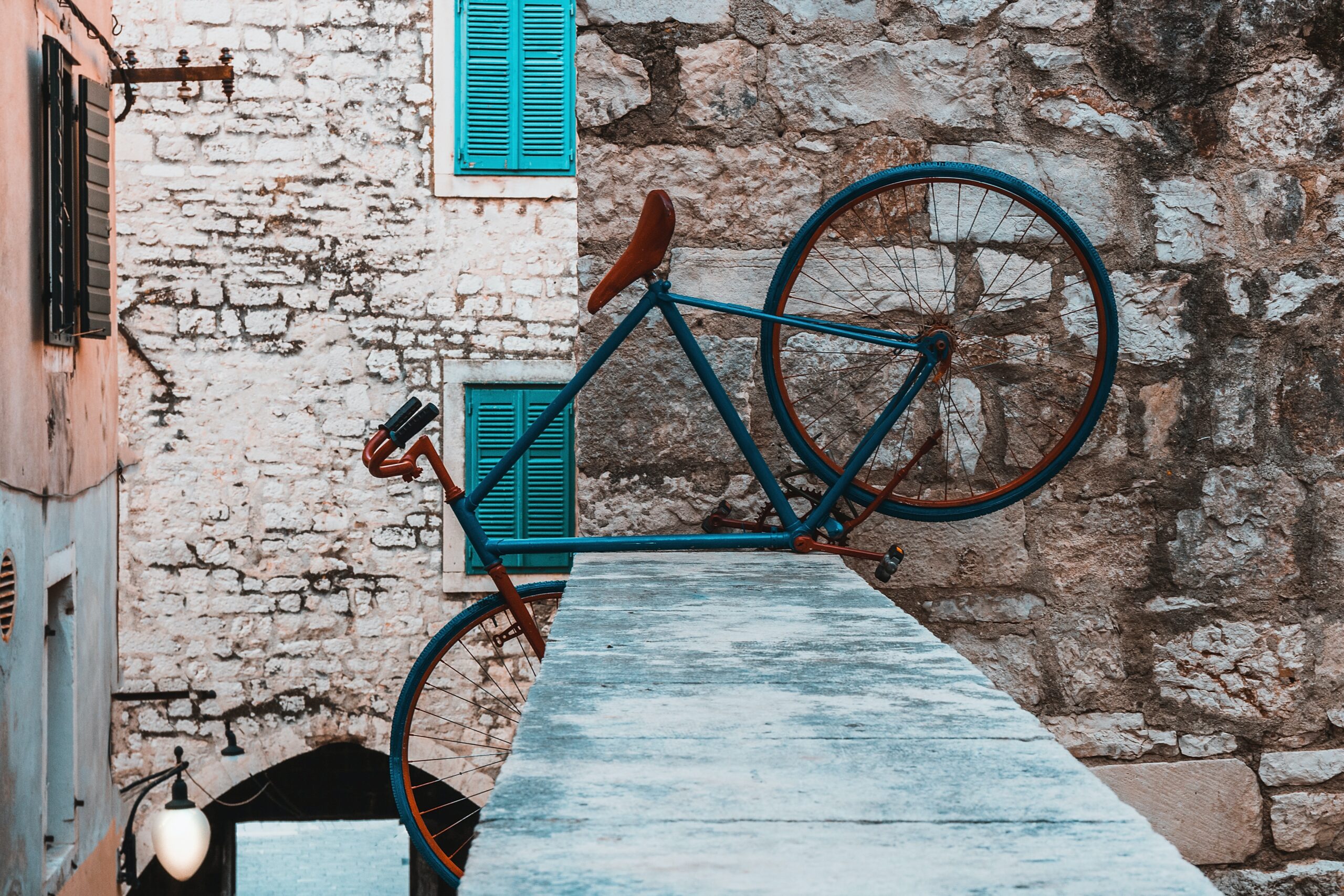
I interpret equilibrium as what results when we let go and let outside forces take over. Balance is achieved when we oppose certain outside forces to maintain a desired state. By simply standing we are opposing gravity and when we let go and do not try to maintain our balance we end up on the ground. The Albert Einstein reference above is related both balance and equilibrium. In life there are outside forces that lead us to fall over on the bicycle, but in order to maintain our balance, we must keep moving forward. The faster we ride, the easier it is to maintain balance, however, what is missing from this is energy expenditure. It may not be economical to ride at 20 mph (or 32 kph) over long distances. Some key considerations with this metaphor include the fact that some people cannot ride a bicycle and there are some talent cyclists who can stop at traffic lights and can maintain their balance while standing. Both of these are opposite end of a skill spectrum when it comes to bike riding. It takes time dedicated to practice in order to develop such a skill. Not everyone wants to allocate their time in such a way, hence some people never learn how to ride, even though they could if they really wanted to.
Why does it matter that we make a distinction between these two terms? The main difference involves an interpretation of balance that is determined by some objective, where equilibrium is the state of being that results when we let go or let the natural forces, subject to key parameters, guide us. Perpetual equilibrium forces such as gravity, for example, as well as random external forces such as wind or earthquakes are often trying to shake us out of balance.
Balance takes energy, effort, discipline, training, and often some planning. Over time, as skills develop and habits are formed, less energy and effort are needed to maintain balance, working against equilibrium forces.
The difference may seem trivial, however, when we interpret equilibrium as something we are trying to defy or possibly change, we can more effectively or efficiently balance our lives the ways we strive to achieve.
My interpretation of these two terms is rather different than seeing these two either as synonymous or rather interchangeable.
Balance is not always a natural state, but it might be – and often is – associated with a desirable state and requires energy to maintain. Equilibrium is closer to a natural state, though not necessarily. It is not always desirable, but can be altered by adjusting the various parameters involved. It is much harder to maintain balance in an environment in which the parameters are such that the equilibrium is much farther from the desired state. It is easier, ie. requires less energy, to maintain balance in environments where the parameters lead to an equilibrium that is much closer to the desired state.
Finding balance is primarily an individual effort. However, equilibrium is what results when we let go. It is much easier to maintain your balance on a 45-degree slab climb with good foot and hand holds than on a vertical or overhanging climb. It is much easier to maintain your balance on a bike when riding on a smooth single track trail than on a rocky technical trail near the edge of a cliff.
Examples of balance vs equilibrium: rock climbing, slacklining, and cycling.
Sometimes the satisfaction in life comes from overcoming difficult challenges in which the desired outcome is very far away from the equilibrium state. If people want to climb a mountain or run a marathon because it makes them feel good, then individuals should be offered the opportunities to choose those activities. Within the workplace, however, these should be parameters in place to make finding balance require as little energy as necessary so more energy can be spent on both personal and organizational goals and promote health and well-being in spaces.
In economics, there is a focus on identifying equilibrium and optimal outcomes. Some of the models identify multiple equilibria – both stable and unstable, which look at the relevant factors leading either toward or away from a particular equilibrium point, as well as desirable and undesirable, which involve normative criteria to evaluate what is desirable. In some models – particularly those involving market failures, such as negative externalities, positive externalities, monopolistic market structures, imperfect or asymmetric information – the equilibrium is determined to be undesirable. In those cases, parameters could be changed, such as tax or subsidy policies to guide
Use of training wheels or net to prevent a ball from reaching the ground.
While balance is ultimately a personal challenge, at Chief Balance Officer we see our objectives as trying to influence the equilibrium parameters such that personal balance goals of employees can be more efficiently realized.
